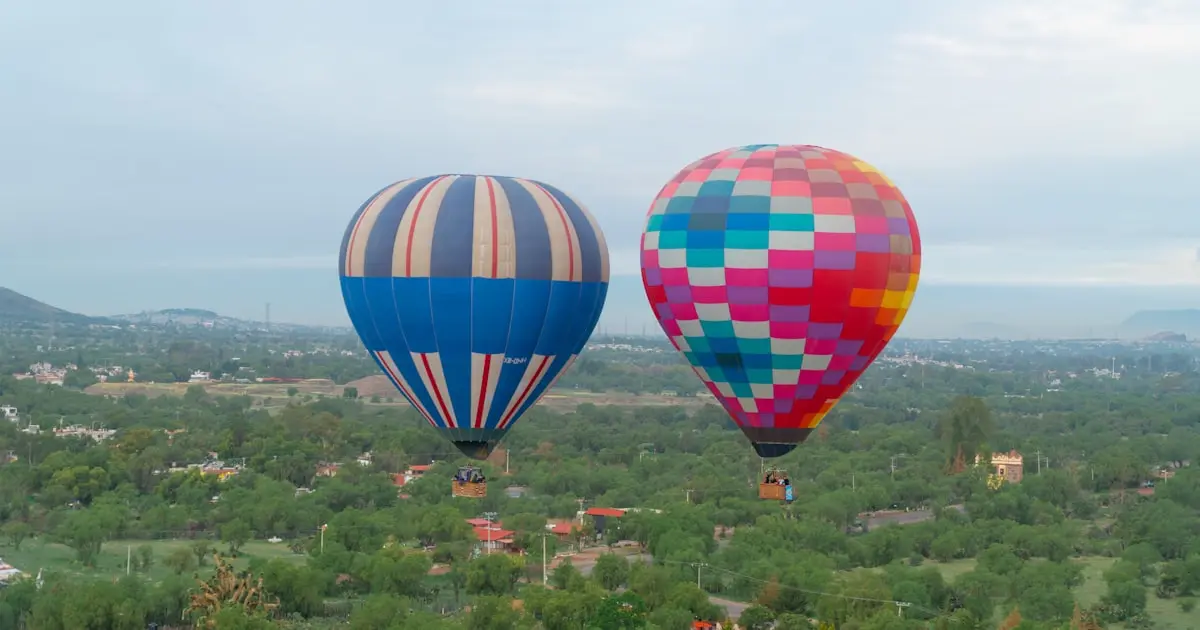
A hot air balloon looks beautifully simple from the ground — a colourful sphere floating serenely above the landscape. But step closer and you discover a carefully engineered machine with dozens of components, each serving a critical purpose. From the crown ring at the top to the wicker floor beneath your feet, every part of a hot air balloon has a name, a function, and a reason for being designed exactly the way it is.
Whether you are preparing for your first balloon ride or simply fascinated by how hot air balloons work, this guide breaks down every component and introduces you to the terminology pilots use.
The Envelope
The envelope is the fabric shell that contains the heated air — the part most people simply call "the balloon." It is the largest single component and the most visually striking. A standard passenger balloon envelope contains approximately 2,800 cubic metres (100,000 cubic feet) of air and stands 20 to 25 metres tall when inflated. To appreciate just how big a hot air balloon is, consider that the envelope alone weighs 100 to 150 kilograms.
The Crown
The crown is the very top of the envelope — the highest point when the balloon is inflated. It houses the parachute valve (covered in its own section below) and the crown ring, a structural ring made of steel or high-strength webbing that provides an attachment point for the load tapes and holds the valve mechanism in place.
On some balloons, the crown is reinforced with additional fabric layers because it receives the most heat exposure — hot air rises and concentrates at the top.
Gores
The envelope is constructed from vertical panels called gores. A standard balloon uses 24 gores, though designs range from 16 to 36 depending on the manufacturer and size. Each gore runs from the crown to the throat, tapering at both ends and widest at the equator.
Gores are stitched together with reinforced seams, and crucially, each vertical seam contains a load tape — a strip of strong nylon or Kevlar webbing that carries the structural load. The weight of the basket, passengers, fuel, and equipment hangs entirely from these load tapes, not from the fabric panels themselves.
Panels
Each gore is subdivided into horizontal sections called panels. These are the individual pieces of fabric that are cut and sewn together to form the gore. The panels are joined by horizontal reinforcement bands that help the envelope maintain its shape under the stress of inflation and flight.
The Equator
The equator is the widest circumference of the envelope — the point where the balloon is at its maximum diameter. This is typically about one-third of the way up from the throat. The equator band is often reinforced because the fabric experiences maximum stress at this point.
The Skirt (Throat)
The skirt, also called the throat or mouth, is the reinforced opening at the bottom of the envelope, directly above the burner. This section is made from Nomex — a fire-resistant aramid fabric — because it is exposed to the direct flame of the burner during every inflation and throughout the flight.
The skirt funnels heat from the burner into the envelope. Its shape and size are carefully designed to ensure efficient heating while preventing excessive heat from reaching the main nylon panels above. Looking up from inside the basket during flight, the skirt glows amber with each burner blast.
The Parachute Valve
The parachute valve (sometimes called the deflation panel or rip panel) is a circular panel at the crown of the envelope. It is the pilot's primary mechanism for controlling descent and for deflating the envelope after landing.
The valve is held in place by a Velcro seal around its circumference. The pilot controls it via a red rope (the deflation line) that runs from the valve down through the interior of the envelope to the basket. A gentle pull on the red rope partially opens the valve, releasing hot air from the top and causing the balloon to descend. A full pull detaches the valve completely, causing rapid deflation — used on landing to prevent the envelope from dragging in wind.
The parachute valve gets its name because the panel, when released, falls inward and sits like a parachute inside the top of the envelope, effectively capping the opening after a partial pull. Understanding this system is essential to understanding how hot air balloons land.
Turning Vents
Some modern balloon designs include turning vents — small openings on opposite sides of the envelope, positioned at roughly the equator level. Each vent has its own control line running to the basket.
When the pilot opens one vent, hot air escapes from that side, creating a small thrust in the opposite direction. This causes the balloon to rotate, allowing the pilot to turn the basket for better passenger views or to position the envelope for landing. Turning vents do not provide directional steering — that is governed by wind direction at different altitudes, as explained in our guide to how hot air balloons are steered.
The Burner System
The burner is the engine of the balloon — the component that generates heat to inflate the envelope and maintain altitude during flight. It is mounted on a burner frame (also called the load frame) above the basket, pointing directly upward into the envelope mouth.
Blast Valve
The blast valve is the main burner, operated by pulling a trigger or lever on the burner unit. When activated, it sends a powerful jet of flame — often two metres or more in height — into the envelope. This is the loud, roaring burst that passengers hear during flight. Each blast typically lasts 5 to 15 seconds and can raise the air temperature inside the envelope by several degrees.
Most modern burner systems are dual burners — two independent blast valves side by side. This provides redundancy (if one fails, the other can sustain flight) and additional power for heavily loaded baskets or cold conditions.
Metering Valve (Whisper Burner)
The metering valve, commonly called the whisper burner, provides a quiet, continuous flow of flame. Rather than the dramatic roar of the blast valve, the whisper burner produces a gentle, steady heat. Pilots use it for fine altitude adjustments and during flights over livestock or in noise-sensitive areas.
The whisper burner is also invaluable for flights near wildlife — a consideration in destinations like the Serengeti or over the Palmerie near Marrakech where the landscape is tranquil.
Pilot Light
The pilot light is a small, always-on flame that ensures the main burner ignites instantly when the blast valve is opened. Without it, there would be a delay — and a build-up of propane — each time the pilot activated the burner. The pilot light is lit during pre-flight preparation and remains burning throughout the flight.
Vaporiser Coil
The vaporiser coil is a metal tube that wraps around the burner. Liquid propane from the fuel tanks passes through the coil, where the heat of the burner converts it into gas before it reaches the burner jet. Gaseous propane burns more efficiently and cleanly than liquid propane, producing a hotter, more controllable flame.
The Basket (Gondola)
The basket — formally called the gondola — is where passengers and pilot stand during the flight. Despite the availability of modern composite materials, virtually all balloon baskets are still made from wicker (rattan cane) hand-woven over a structural frame of aluminium or stainless steel tubing.
Wicker endures because it uniquely combines three essential properties: it absorbs impact (flexing on landing rather than transmitting jolts to passengers), it is extremely light relative to its strength, and it is repairable (a damaged section can be re-woven without replacing the entire structure). A standard basket takes 80 to 120 hours of hand-weaving to complete. Learn more about the construction process in our guide to how hot air balloons are made.
Key Basket Features
- Padded suede rim: The top edge of the basket is lined with padded suede or leather, providing a comfortable rail to hold and lean against during flight.
- Partition walls: Larger baskets (those carrying 8 to 20 passengers) are divided into sections by internal wicker walls. These give passengers something to brace against during landing and distribute weight more evenly across the floor.
- Foot holes: Small openings woven into the side walls that serve as steps for climbing in and out. Some baskets also have hinged doors.
- Floor: Woven wicker over a plywood base, providing a stable, slightly flexible standing surface.
- Fuel tank compartments: The corners of the basket house cylindrical propane tanks, typically two to four per basket, secured by webbing straps.
- Instrument holders: Brackets and pouches attached to the interior walls hold flight instruments, maps, and communication equipment.
The Load Frame
The load frame is the stainless steel framework that connects the basket to the envelope. It sits above the basket and supports the burner. Flying wires — steel cables — run from the corners of the basket upward to the load frame, and from the load frame to carabiners that attach to the load tapes at the base of the envelope.
The flying wires and load frame transfer the weight of the basket and its contents to the load tapes sewn into the envelope's gore seams. Every connection point uses rated carabiners or shackles that are inspected before each flight.
Flight Instruments
A balloon pilot's instrument panel is simpler than that of a fixed-wing aircraft or helicopter, but each instrument is essential.
- Altimeter: Measures altitude above sea level. Uses atmospheric pressure and is calibrated before each flight.
- Variometer: Measures the rate of climb or descent in feet or metres per minute. This is arguably the most important instrument — it tells the pilot whether the balloon is gaining or losing altitude, and how quickly.
- Envelope temperature gauge (pyrometer): Measures the air temperature inside the crown of the envelope. The pilot monitors this to avoid overheating the fabric (which degrades nylon) and to manage lift efficiently.
- Compass: For orientation, though not for navigation in the traditional sense — a balloon goes where the wind takes it.
- GPS: Modern balloons carry GPS units for position tracking, ground speed measurement, and communication of location to the chase crew.
- Radio: VHF aviation radio for communication with air traffic control (where required) and with the ground crew chase vehicle.
Ballooning Terminology
Beyond the physical parts, the world of hot air ballooning has its own vocabulary. Here are terms you might hear your pilot use during a Marrakech balloon flight.
- Weighing off: The moment of lift-off — when the balloon becomes lighter than the air it displaces and begins to rise. The pilot "weighs off" by heating the air until the balloon is neutrally buoyant, then adding a touch more heat.
- False lift: A temporary upward movement caused by a gust of wind or thermal, rather than by heated air. The pilot must distinguish between genuine lift and false lift to maintain control.
- Contour flying: Flying close to the terrain, following the contours of hills, valleys, and treetops. Skilled pilots use this technique for dramatic passenger experiences and to access different wind layers close to the surface.
- Box: A wind pattern where winds at different altitudes blow in different (sometimes opposite) directions. By ascending or descending into different layers, the pilot can effectively "steer" the balloon — the closest a balloon comes to directional control.
- Chase crew: The ground team that follows the balloon in a vehicle, meets it at the landing site, and helps with deflation and pack-up. The chase crew's role is indispensable, as landing locations cannot be precisely predetermined.
Understanding these terms deepens the experience of any balloon flight. When your pilot talks about "finding the box" or "weighing off," you will know exactly what they mean.
See Every Part in Action Over Marrakech
The best way to understand a hot air balloon is to fly in one. Our sunrise flights over the Atlas Mountains and the Palmerie give you an hour to watch every component at work — from the roar of the blast valve to the gentle hiss of the whisper burner, from the Velcro release of the parachute valve to the creak of wicker on landing.
Book your Marrakech balloon flight today and experience the anatomy of flight first-hand. Check our safety guide and what to wear tips to prepare for an unforgettable morning.
Want to fly? Browse every Marrakech hot air balloon option and pick the one that fits your trip.